

Key takeaways
- Dental implant removal recovery time is individual. A general range is first days of soreness, about 1 to 2 weeks for the gum surface, and a few months before later decisions.
- Follow the written aftercare you were given. Call if bleeding, pain, or swelling is getting worse, or if you have fever or drainage.
- Bone grafting is not automatic. If a graft is used, Shifa Dental’s bone grafting page describes a few weeks of early healing and about 3 to 6 months before an implant may be placed.
- A published review found replacement was often planned 4 to 6 months after removal. That is a study pattern, not a promise for your case.
- Choose Plano or Garland on the shared scheduler to request an implant evaluation. The exam, not this article, sets your plan.
Dental implant removal recovery time depends on why the implant is being removed, how involved the procedure is, and whether the site needs more care. There is no single number of days that fits everyone. A clearly labeled general range is first days of soreness, about 1 to 2 weeks for the gum surface, and a few months before a later decision. An exam is the only way to estimate your timeline.
Request an implant evaluation. Choose Plano or Garland on the scheduler.
What is a general dental implant removal recovery time?
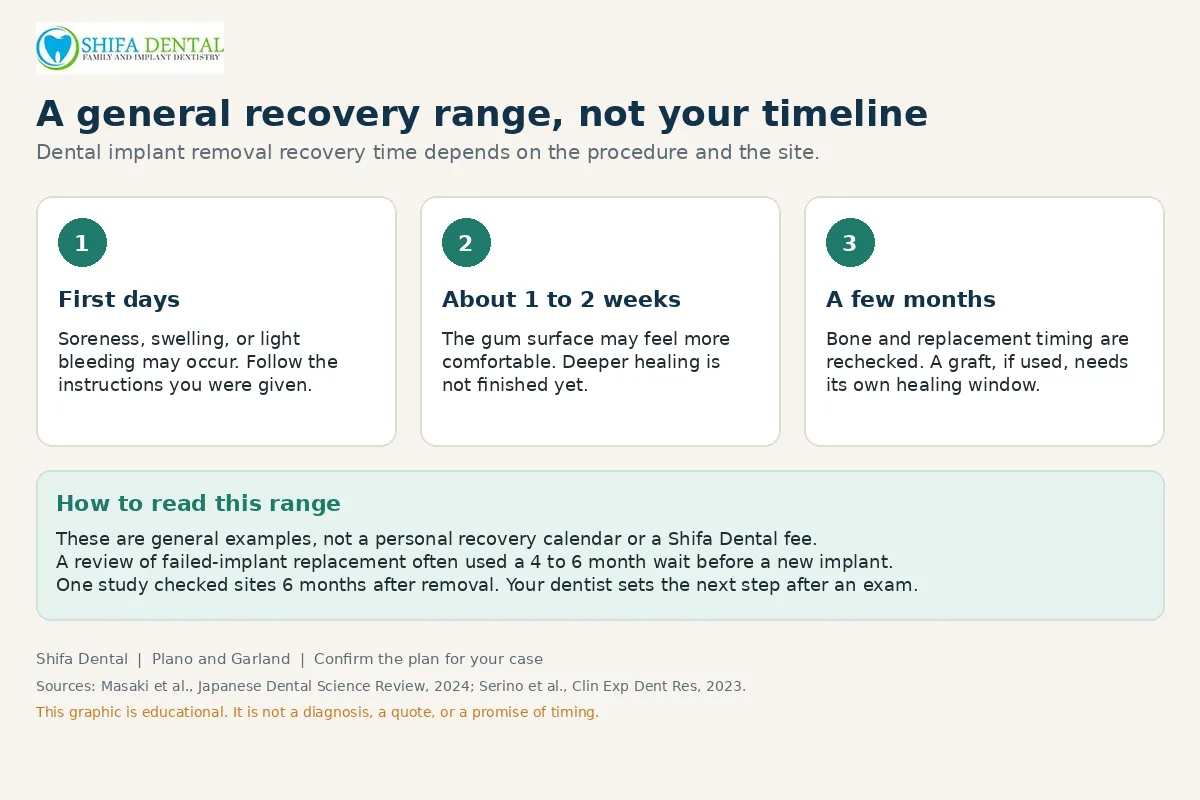
Use the range below as a planning example, not a personal calendar. Early tenderness can ease while the deeper site is still healing. The dentist who examines you can say which part of the range is more likely and what would change it.
| General phase | What it may involve | What it does not mean |
|---|---|---|
| First days | The area may feel sore. Swelling or light bleeding can occur. Follow the instructions given for rest, food, cleaning, and medicine. | It does not mean every person has the same amount of discomfort, or that soreness alone proves a problem. |
| About 1 to 2 weeks | The gum surface may feel more comfortable. A review visit may check the area and, if stitches were used, the plan for them. | A calmer gum surface does not prove that bone healing or a replacement decision is finished. |
| A few months | The dentist may recheck the site before talking about observation, grafting, or replacement. One study looked at sites 6 months after removal. | A few months is not a deadline. Infection, bone shape, and your health can move the plan. |
This table is educational. It is not a Shifa Dental fee, a quote, or a guarantee that your healing will match these examples. If the office gives you a different range, follow that range.
Why does dental implant removal recovery time vary?
Implant removal is not one identical procedure. A loose implant, a broken part, a restoration that cannot be kept, or a problem in the nearby tissue can lead to different plans. A symptom by itself does not prove the cause or mean that removal is needed.
A 2024 review of treatment strategies says implants are removed when they are mobile or when the restoration cannot be kept, such as after a fracture. For inflammation around an implant, the decision also depends on age, appearance needs, the site, and how much bone has changed. The same review says reverse torque, which unscrews the implant, should be the first choice when it can be used because it is less invasive. A more invasive method can leave a larger bone defect and may then need more grafting. That difference can change both the procedure and the recovery.
Read the review of treatment strategies for dental implant removal, then ask how your findings relate to the options being discussed. The review is background. It cannot predict your healing.
- Reason for removal: Mobility, fracture, position, and tissue health can point to different plans.
- How the implant is removed: A less invasive method may disturb less bone than a method that has to cut bone away.
- Extra care: Cleaning infection or adding a graft adds steps and a separate healing window.
- Health and habits: The review links smoking, diabetes, and other health factors with healing risk. Share medicines, allergies, and tobacco use. Do not stop a prescribed medicine on your own.
Shifa Dental’s dental implants page explains evaluation, imaging, and why later timing depends on healing. It is a service overview, not a decision that removal or a new implant is right for you.
What aftercare steps should you follow?
The written instructions from the treating office outrank any general list. Ask for those instructions before you leave, including who to contact if a symptom changes. Use the steps below to know what to clarify. Do not treat them as a substitute for the plan you were given.
- Protect the site on the first day. Ask whether you should bite on gauze, rest, and avoid rinsing, spitting, or using a straw until the office says it is safe.
- Use only the medicine you were told to use. Do not take a leftover prescription or change a dose on your own. Ask before using a nonprescription pain reliever if you take other medicine.
- Choose soft foods at first. Ask when you can return to your usual meals. Chew away from the area until you are told otherwise.
- Clean the rest of your mouth, not the wound. Ask when you may brush near the site and whether a rinse was recommended. Do not scrub, poke, or pull at the area.
- Skip smoking and alcohol while the site is healing. Both can interfere with healing. Ask the office how long to avoid them for your procedure.
- Limit heavy activity until you are cleared. Ask when you can return to work, exercise, and driving, especially if you were given a sedative or told to bring an escort.
- Keep the review visit. A calmer feeling is not proof that healing is complete. The visit is where the dentist checks the site and explains the next decision.
Call the office promptly if bleeding does not ease as instructed, if pain or swelling is increasing, or if you notice fever, drainage, or another change that worries you. Seek urgent medical care for trouble breathing or swallowing, rapidly spreading swelling, or another emergency. Do not wait for a routine dental visit in that situation.
When you call, say whether the implant is already out, when the symptom started, and whether it is better, the same, or worse. That helps the team decide if you need to be seen sooner. A phone call still cannot replace an exam when one is needed.
How do bone grafting and replacement timing fit in?
Removal and replacement are related, but they are not always one visit. The dentist needs to know why the implant is coming out, what the bone and gum look like, and whether infection is present before recommending what comes next. Do not assume a new implant can go in the same day, or that it is the right choice for every person.
Bone grafting is used only when the jaw does not have enough bone for the plan. Shifa Dental’s bone grafting page says a graft is necessary only if the jaw lacks the density or volume to support an implant. The same page says initial healing occurs in a few weeks, while the graft usually needs 3 to 6 months to fuse with the natural bone before an implant can be placed. That page describes grafting for implant support. It is not a statement that every removal needs a graft, and it is not a personal fee.
Published research points the same way, with an important limit. A systematic review summarized in the 2024 removal review found that replacement was generally planned 4 to 6 months after removal. The weighted survival of those replacement implants was 86.3% at 1 to 5 years, and survival was lower after a second or later replacement. That figure is a study result, not a Shifa Dental success rate and not a promise that a new implant will last.
A separate 2023 study checked 31 sites six months after implants with ongoing tissue inflammation were removed, without reporting a graft at those sites. The part of the socket that had not been damaged by that inflammation healed completely. The bone crest dropped about 0.8 mm, and the gum became about 0.4 mm lower and 0.7 mm narrower. Changes were larger where the outer bone wall was already missing. Read the study of tissue changes six months after implant removal. These are measured averages from one group, not a prediction of how your site will look.
Ask the dentist which of these paths is even being considered:
- No graft, and no immediate replacement: The site is observed, then rechecked before any replacement talk.
- Graft at removal, replacement later: The graft needs its own healing window. The bone grafting page uses about 3 to 6 months before an implant may be placed.
- Replacement at the same visit: Only if the dentist finds enough stable bone and no reason to wait. This is not the default.
- A different replacement: A bridge, denture, or other option may fit better. That choice depends on the exam and your preferences.
If you want background on other ways to replace a tooth, Shifa Dental’s pages on replacing missing teeth and bridges and implants are useful question lists. They do not decide which option is suitable.
What can you expect from an implant removal evaluation?
Bring a current list of medicines, supplements, allergies, and relevant health conditions. Describe when the concern started, whether it is changing, and whether it affects eating or cleaning. If you have records or images from the original implant, bring those too. You do not need the technical name for each part. Describe what you can see or feel.
Ask the dentist to separate what is already recommended from what is only possible. A useful checklist is the reason for the advice, whether grafting is being considered, what the first days should feel like, and which symptoms should prompt a call. Also ask what has to be rechecked before a replacement is discussed. If imaging is suggested, ask what question it is meant to answer. Shifa Dental’s dental X-ray page describes cone-beam imaging for implant and oral-surgery planning. Imaging is not automatic.
If you want a second opinion, bring the recommendation, the images you have, and your questions. Another clinician may agree or may suggest a different sequence. Either way, the decision still rests on an exam of your site.
How should you choose a Plano or Garland visit?
Shifa Dental has offices in Plano at 5509 Pleasant Valley Dr #90A and in Garland at 1918 N Plano Rd. Hours can differ by office and can change, so confirm the current hours for the office you want before you come in. Phone numbers printed on the website also differ by page, so use the number listed for that office rather than a number copied from an article.
The shared scheduler asks you to choose Plano or Garland before it shows that office. After you choose, confirm the address on the screen matches the office you wanted. Garland should show 1918 N Plano Rd. Plano should show 5509 Pleasant Valley Drive #90a.
Schedule an implant consultation. On the next screen, choose the Plano or Garland office you prefer.
You can also review the Plano office page or the Garland office page before you book. A service page does not mean every procedure is available that day at that office. Confirm the service when you request the visit.
Frequently asked questions
How many days does dental implant removal recovery take?
There is no single number. A general example is first days of soreness, about 1 to 2 weeks for the gum surface to feel more comfortable, and a few months before later decisions. Ask the clinician who examines you for an estimate tied to your plan.
Does implant removal always require bone grafting?
No. A graft is considered when the bone is not enough for the next step. Shifa Dental’s bone grafting page says grafting is necessary only if the jaw lacks the density or volume to support an implant. Ask what the exam shows and what alternatives exist.
Can a new implant be placed at the same time?
Sometimes, but not as a default. The 2024 review describes both early and delayed replacement, and says delayed placement is often used when the bone needs to heal first. A clinician has to assess the site before recommending timing.
Is discomfort after removal always a sign of a complication?
Not necessarily. Some soreness can follow the procedure. Increasing pain, worsening swelling, fever, drainage, bleeding that does not ease as instructed, or trouble breathing or swallowing should be reported promptly. Follow the aftercare you were given.
Can another person’s recovery timeline tell me what to expect?
No. Another person’s story is not an estimate for your procedure, health, or healing. Use the treating clinician’s instructions and the follow-up visit to guide the next decision.
Choose the Plano or Garland office you prefer and request an evaluation to discuss your symptoms, the likely steps, and what has to heal before any replacement talk.