

Sometimes. Dental insurance covers an implant only when your own written policy lists that implant as a covered service. The answer depends on exclusions, any waiting period, the yearly maximum still left, and whether the plan treats the post, the abutment, and the crown as separate lines. Shifa Dental accepts most plans at the Plano and Garland offices. Accepting a plan is not a promise that your plan will pay.
Ready to review a missing tooth and your benefits? Schedule an appointment and choose the Plano or Garland office before an address appears. The visit is an exam and a personal estimate, not a coverage guarantee.
Does dental insurance cover implants on your plan?
There is no single national rule. The American Dental Association says dental benefits vary widely. Common limits include preexisting conditions, annual maximums, and other cost controls. One plan can pay part of a related crown and still exclude the implant post. Another can list implants as major care, then apply a waiting period or a low yearly cap.
Read the benefit booklet, not a general line that a dental office takes insurance. Look for four labels:
- Covered, limited, or excluded. The implant post, the abutment, and the crown can be three different lines.
- Missing-tooth wording. The ADA says some group plans limit care for a dental condition you already had when you enrolled, such as a missing tooth. If the plan uses that limit, prior creditable coverage can shorten it. Ask the insurer whether your missing tooth falls under that wording.
- Waiting period. Major services are often delayed after the plan starts. The length is in your booklet, not in a general average.
- Annual maximum. Many plans reimburse only up to a yearly dollar cap, even when treatment costs more. The cap can be for one person or for the family.
A percentage in a brochure is not your payment. Plans often pay a share of their own fee schedule. The ADA says the amount a plan calls customary may be lower than a dentist’s usual fee. There is no single method for setting that amount. Plans often do not publish the schedule. Your share can be higher than a quick percentage suggests.
Network status changes the math too. A plan may pay more when you see a contracted dentist and less when you do not. Shifa Dental can tell you which plans the offices are set up to bill. Only your insurer can say whether this plan treats the office as in network for an implant claim.
The implant, the abutment, and the crown are separate lines
An implant replaces a tooth root with a post placed in the jaw. A connector, called an abutment, joins that post to the crown you see. The American Association of Oral and Maxillofacial Surgeons diagrams those three parts and describes an implant as a long-term way to replace a missing tooth. Healing time varies. Many cases need about three to six months before the final tooth is ready. Same-day teeth are for selected candidates only. They are not completed treatment, and they are not a coverage category.
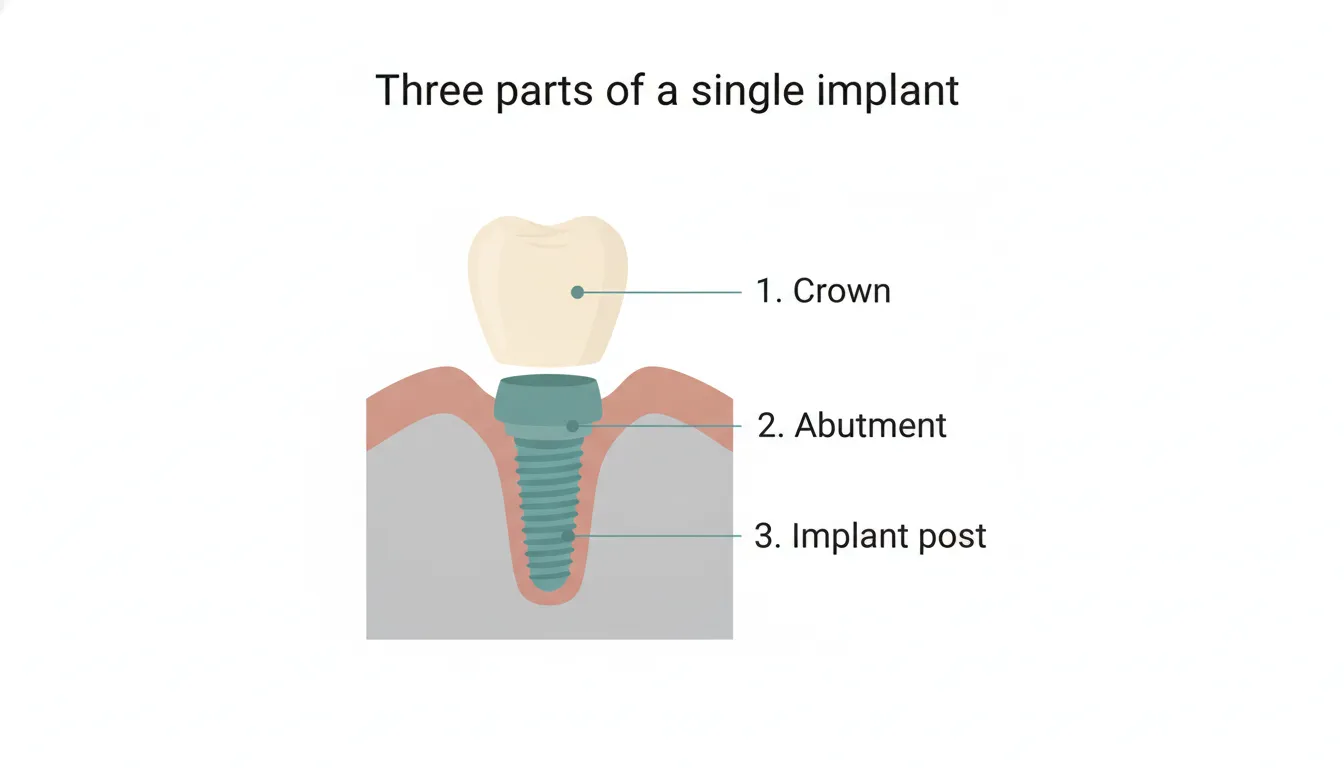
Your booklet may treat each piece differently. The post may be excluded even when a crown on a natural tooth is a major service. An implant-supported bridge is not the same benefit as a tooth-supported bridge. The bridge cost and insurance guide covers bridges, and the crown coverage article covers crowns on natural teeth. Neither one answers the implant question.
Grafting, an extraction, and imaging can each be allowed, limited, or left out. The bone grafting page describes that visit. Full-arch care, including All-on-4 style treatment, is a different scope from one missing tooth. The All-on-4 implant page describes that option. Do not assume a single-tooth benefit applies to a full arch. A dental plan may still call an implant elective even when chewing is hard. If someone says a medical plan might apply, ask that insurer for the clause in writing.
Published ranges are not what insurance pays
The dental implant service page, checked November 1, 2026, lists published ranges. A single implant is $2,500 to $6,000. An implant-supported bridge is $6,000 to $15,000. Full-mouth implant treatment is $15,000 to $30,000 or more. Those figures are not a quote, and they are not what insurance pays. The page does not say whether the full-mouth figure is one arch or both, so treat it as the page’s full-mouth range, not a settled arch count.
Your fee depends on how many implants you need, the restoration, grafting or other procedures, materials, and complexity. The service page says the office uses CBCT imaging to plan implant placement. That scan is part of planning for appropriate cases. It is not a promise that every visit includes one, and it is not automatically a covered line. A dated single-implant special is not on that page now, so do not count on an older advertised price.
| What you are checking | Why it changes what you may owe |
|---|---|
| Exclusion or missing-tooth clause | The plan may pay nothing for an implant even when other dentistry is covered. |
| Waiting period | Major care may be delayed until a set date after enrollment. |
| Deductible and coinsurance | You may pay the deductible plus a share of the allowed amount. |
| Annual maximum | Payment stops at the yearly cap, even if treatment costs more. |
| Related procedures | Grafts, extractions, abutments, and crowns can be allowed or denied on their own. |
| Fee schedule | The plan may pay a percentage of its own allowable fee, not of the office fee. |
A hypothetical example, not your bill
This example is hypothetical. The dollars are made up so the math is easy to see. They are not a Shifa Dental fee, not a plan payment, and not a quote for your visit.
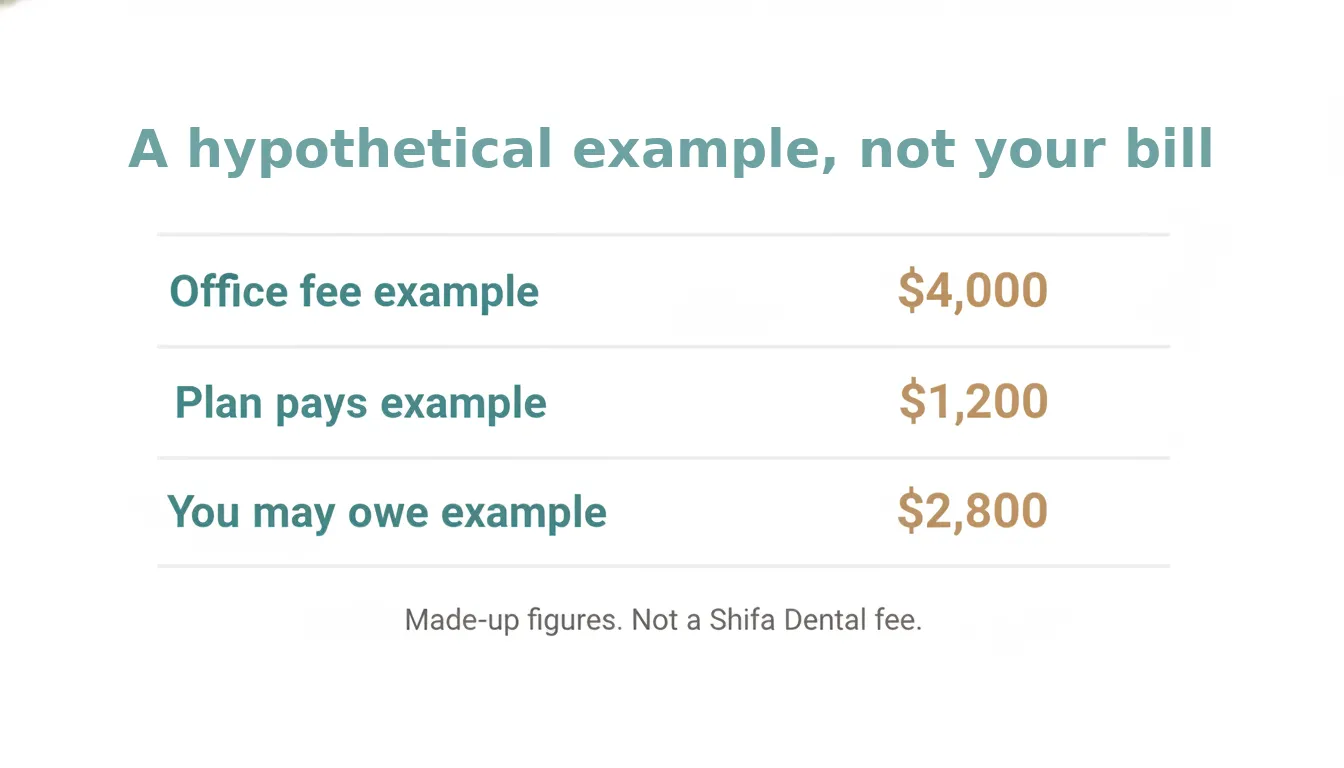
In the made-up chart, the sample fee is four thousand dollars. The sample plan pays one thousand two hundred dollars. The sample patient may then owe two thousand eight hundred dollars, plus anything the plan leaves out, such as a graft. If that sample plan has only five hundred dollars of yearly maximum left, the plan share in this example falls to that remainder. None of those amounts is your bill.
If a missing-tooth clause excludes the implant, the sample plan in this example pays nothing. Two neighbors with the same missing tooth can owe different amounts because their plans, used benefits, and treatment differ. Bone, gum health, the bite, and medical history still decide whether an implant is appropriate. A payment decision does not turn a poor candidate into a good one.
Call the member-services number on your card and ask for the answer in writing when the plan will send one. These questions are a checklist, not a Shifa Dental benefit.
- Are the implant post, abutment, and crown covered, denied, or paid as an alternate benefit?
- Is a tooth that was already missing when you joined this plan excluded?
- Is a waiting period still running, and on what date does it end?
- What deductible and annual maximum remain for this plan year?
- Does the claim need a predetermination, and is this office in network for the implant?
An alternate benefit is not the same as covering the implant. Some plans pay only what they would have paid for a bridge or a partial denture and leave the rest to you. Ask which procedure they are using as the alternate, and whether you may still choose the implant. Write down the date, the reference number, and the name of the person you spoke with.
Bring that note to the visit. Shifa Dental can explain the treatment and send the records your plan asks for. The insurer still decides the claim. A predetermination is the plan’s estimate. It can change if you use other benefits first, if the plan year resets, or if the treatment changes after the exam. Also ask whether the plan pays the dentist or reimburses you. That detail changes when you pay. It does not change whether the implant is covered.
What to bring to the Plano or Garland visit
Bring the insurance card, a photo of the front and back, and any written note from member services. If you already had a predetermination, bring that letter too. Tell the dentist about medicines, medical conditions, and whether the tooth has been missing for months or years. Those facts shape the exam. They do not change the plan’s written rules.
The dentist looks at the site, the bite, and whether the jaw can support a post. Some patients need grafting first. Some are better served by a bridge or a denture. The implant service page walks through that visit. A strong clinical candidate still needs the insurer’s answer before anyone can say what the plan may pay.
If the plan pays little or nothing
A denial is a plan decision. It is not a statement that an implant is the wrong treatment. Some patients still choose an implant and pay the balance. Others compare a bridge or a denture after the exam. Those are different treatments. Shifa Dental sees patients whether or not they have insurance. Payment help is separate from a dental plan, and none of it is an approval.
- Financing can include CareCredit and in-house interest-free plans for qualified applicants. CareCredit needs a credit check. In-house plans are for qualified Shifa Club members and depend on the treatment. Do not assume a set number of months or a zero-interest term. Cherry is listed on the financing page as another interest-free option for applicants who qualify. The page’s approval-rate claim is the vendor’s wording, not a Shifa Dental guarantee.
- The Shifa Smiles Plan is a discount membership, not insurance. Checked November 1, 2026, the initial member is $175 and an additional member is $150. A child under 13 is $125, and a family of four with two members under 13 is $499, plus a one-time nonrefundable $20 processing fee.
- Included yearly care is two regular exams with X-rays, two regular cleanings, one limited or emergency exam, and one fluoride treatment at no charge. That included care is not an implant.
- The 40 percent discount on other procedures does not include orthodontics, care rendered by a specialist, or lab fees. It cannot be used with insurance or with promotions and coupons. Ask whether your implant and the dentist providing it qualify before you count that discount.
Plano patients can review dental implants in Plano. Garland patients can review dental implants in Garland. Those pages describe the visit. They do not list a covered amount. Allen and Richardson patients are welcome at either office. Those cities are not extra Shifa Dental locations.
Frequently asked questions
Does dental insurance cover implants for a tooth lost years ago?
Maybe not. Some plans limit a tooth that was already missing when you enrolled. Ask the insurer to read that section of your booklet. Shifa Dental cannot see the clause from the office name alone.
If the plan covers crowns, does it cover the implant too?
Not automatically. A crown on a natural tooth and an implant post can sit in different benefit classes. Ask about the implant post, the abutment, and the crown as separate lines.
Will the office tell me the exact amount the plan will pay?
No. The office can examine you, explain the treatment, and help you request a predetermination when the plan allows one. The insurer decides the claim. The decision can change if you use benefits before treatment.
Can the Shifa Smiles Plan be used with dental insurance?
No. The membership cannot be used together with insurance or with coupons. It is a discount plan with its own fees and exclusions, including specialist-rendered care and lab fees.
Do I need a visit if I only want to know about coverage?
You can call the insurer without a dental visit. You need an exam if you want a personal treatment plan and fee. Coverage and the clinical recommendation are two separate answers.
Choose an office and request the visit
Start with the booklet and the member-services line. Then choose the Plano office at 5509 Pleasant Valley Dr #90A or the Garland office at 1918 N Plano Rd. Schedule an appointment and pick that office before an address appears. The dentist can talk through whether an implant fits your case. Only your plan can say whether it will pay.